These Grade 5 English resources and worksheets have answers also given in the downloadable links below.
Worksheet 1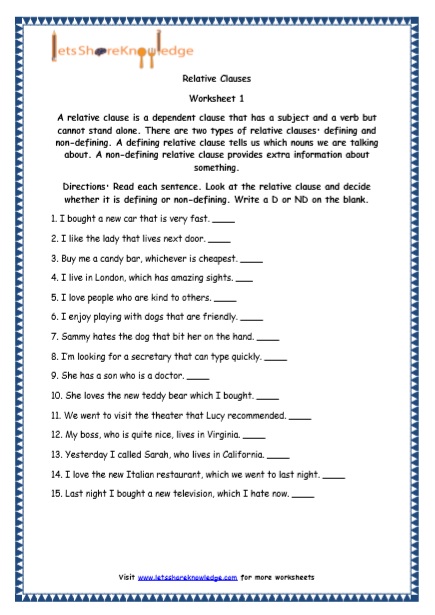
|
Worksheet 2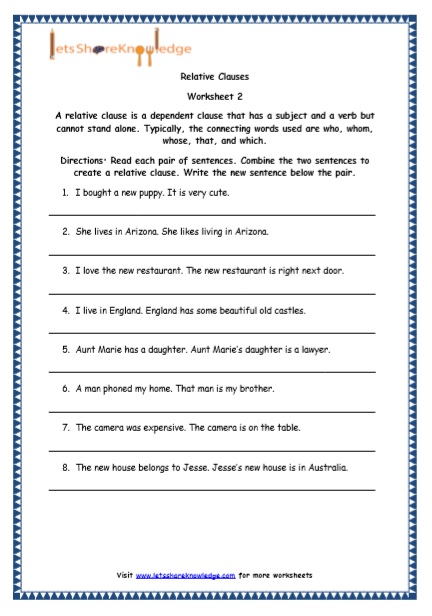
|
Worksheet 3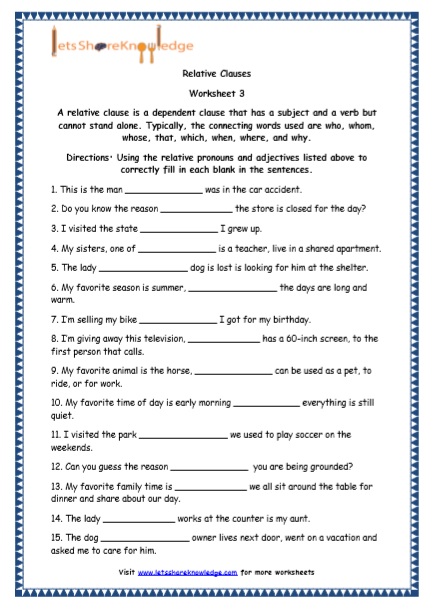
|
Click here for more Topics on Grade 5 English Worksheets!!
]]>These Grade 5 English resources and worksheets have answers also given in the downloadable links below.
Worksheet 1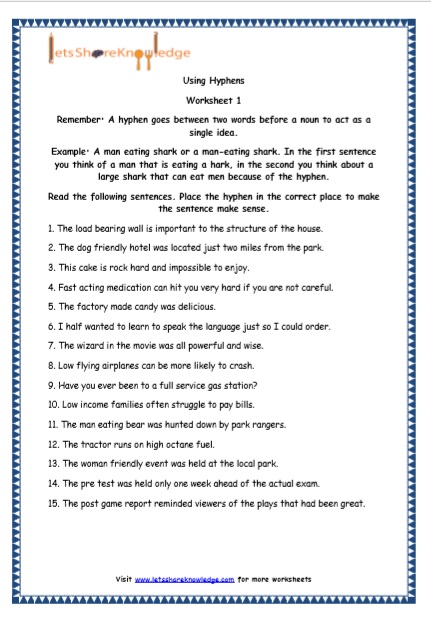
|
Worksheet 2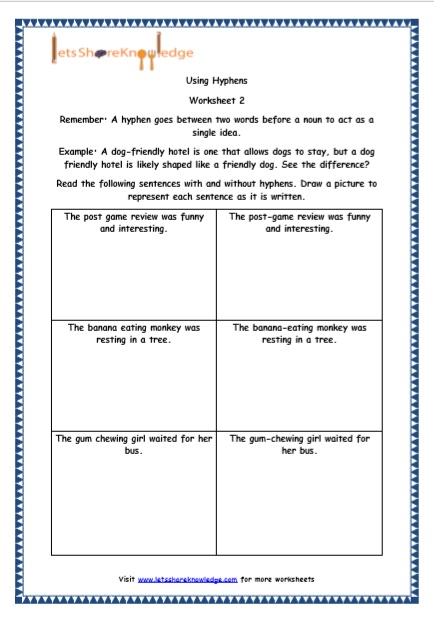
|
Worksheet 3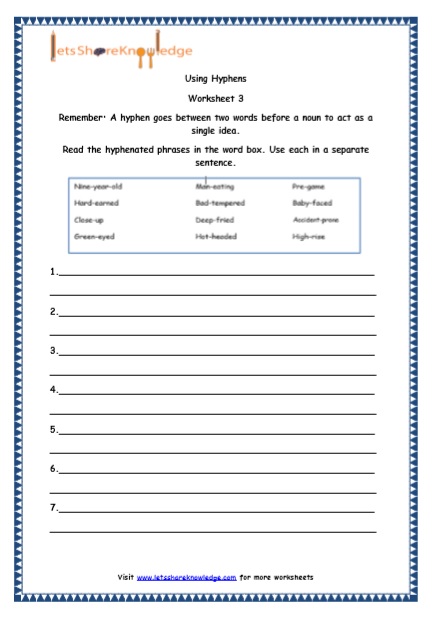
|
Click here for more Topics on Grade 5 English Worksheets!!
]]>These Grade 5 English resources and worksheets have answers also given in the downloadable links below.
Worksheet 1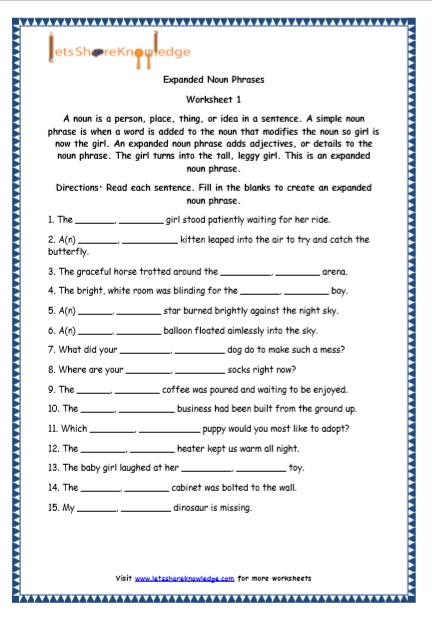
|
Worksheet 2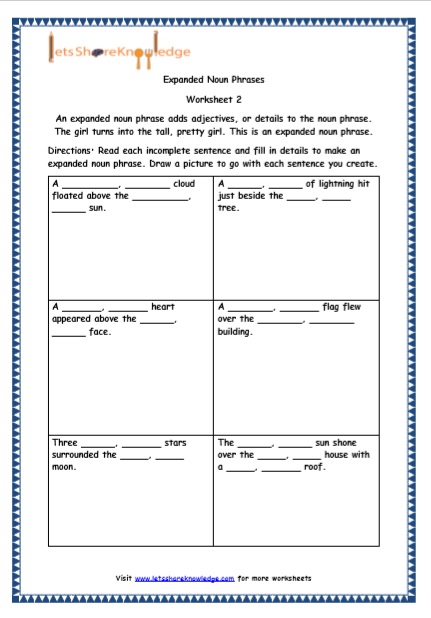
|
Worksheet 3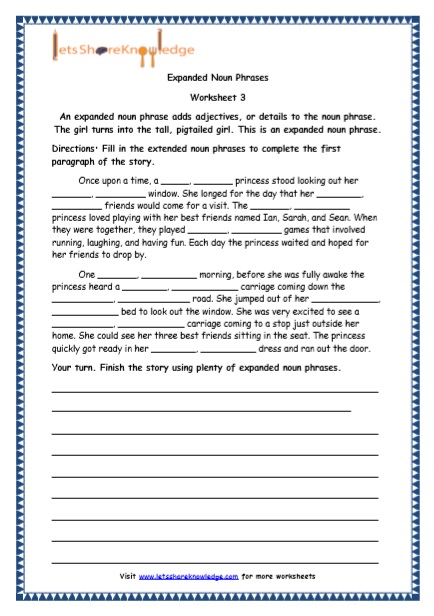
|
Click here for more Topics on Grade 5 English Worksheets!!
]]>These Grade 4 English resources and worksheets have answers also given in the downloadable links below.
Creative Writing
Writing or telling a story can be simple, a few simple sentences that give a beginning, middle, and end. However, creative writing is telling a story with detail that comes from the imagination or is loosely based on real events.
There are a few tips that can help make your creative story better. Since many creative stories are short, we will focus on short creative stories.
- Begin your story as close to the action as possible. The first paragraph should be catchy and detailed rich to grab the reader’s attention.
- Develop your characters and background, but do not go overboard. Give your reader enough information to be able to picture your characters and understand their actions, but not so much information that the story is lost in explanation.
- Choose a point of view. Is your story told by a character? Maybe an omnipresent narrator that sees all? Stick with one point of view to keep it simple.
- Do not be afraid to use dialogue to enhance the writing.
- Choose a setting and share the time, atmosphere, context, and location with your reader with some detail. If your story is in a jungle, close your eyes, picture a jungle, and then write about what you imagine.
- Create some conflict in your writing to keep the reader interested. Allow this to come to a crisis or climax in which the characters must make a decision.
- End the story well with a resolution. While all problems do not have to be solved, do not leave your readers hanging unless this is a series. Even in a series of short creative stories, some resolution should be made.
- Have fun! Creative writing is about having fun with your writing while using proper skills. Let your imagination take you to new lands with unique situations that will keep the reader wanting more.
Explanation
|
|
Worksheet 1
|
Worksheet 2
|
Worksheet 3
|
Worksheet 4
|
Worksheet 5
|
Worksheet 6
|
Worksheet 7
|
Worksheet 8
|
Worksheet 9
|
Worksheet 10
|
Worksheet 11
|
Worksheet 12
|
Worksheet 13
|
Worksheet 14
|
Worksheet 15
|
Worksheet 16
|

Click here for more Topics on Grade 4 English Worksheets!!
]]>These Grade 4 English resources and worksheets have answers also given in the downloadable links below.
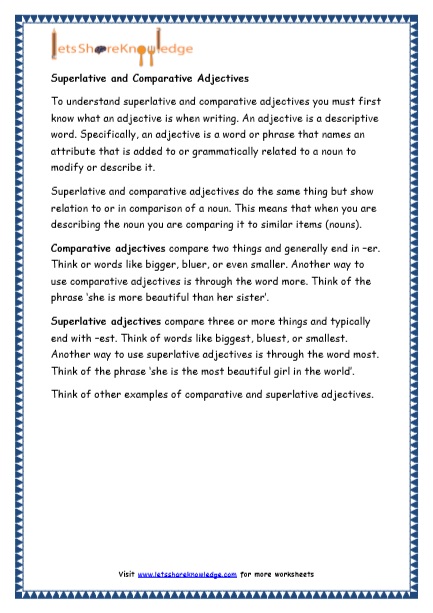
Superlative and Comparative Adjectives
To understand superlative and comparative adjectives you must first know what an adjective is when writing. An adjective is a descriptive word. Specifically, an adjective is a word or phrase that names an attribute that is added to or grammatically related to a noun to modify or describe it.
Superlative and comparative adjectives do the same thing but show relation to or in comparison of a noun. This means that when you are describing the noun you are comparing it to similar items (nouns).
Comparative adjectives compare two things and generally end in –er. Think or words like bigger, bluer, or even smaller. Another way to use comparative adjectives is through the word more. Think of the phrase ‘she is more beautiful than her sister’.
Superlative adjectives compare three or more things and typically end with –est. Think of words like biggest, bluest, or smallest. Another way to use superlative adjectives is through the word most. Think of the phrase ‘she is the most beautiful girl in the world’.
Think of other examples of comparative and superlative adjectives.
Explanation
|
|
Worksheet 1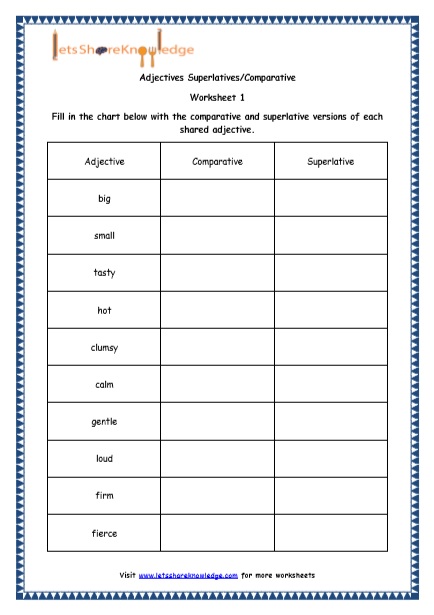
|
Worksheet 2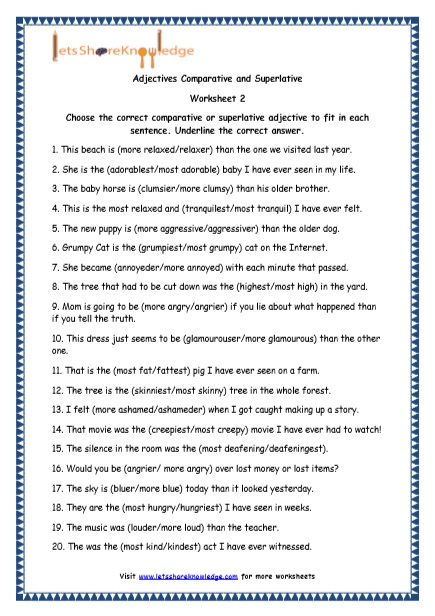
|
Worksheet 3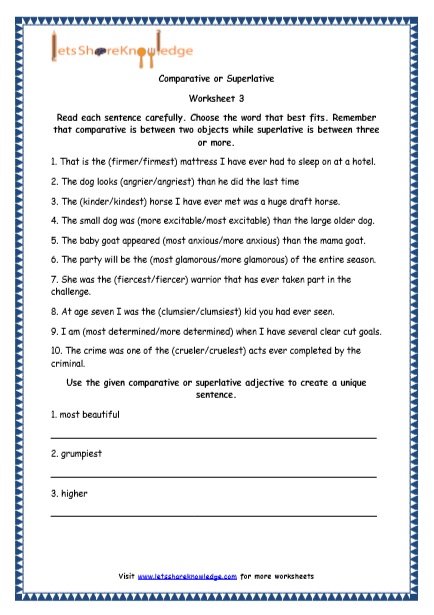
|
Worksheet 4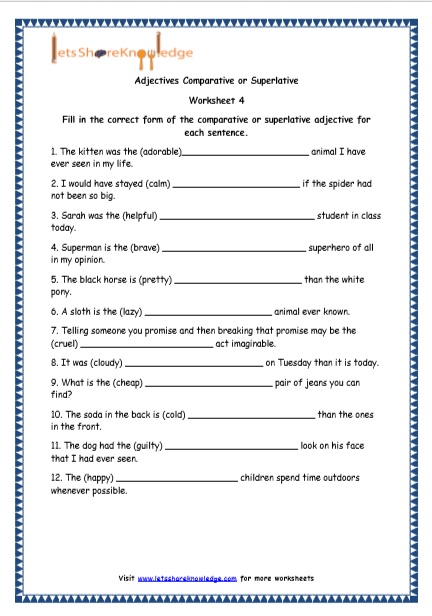
|
Worksheet 5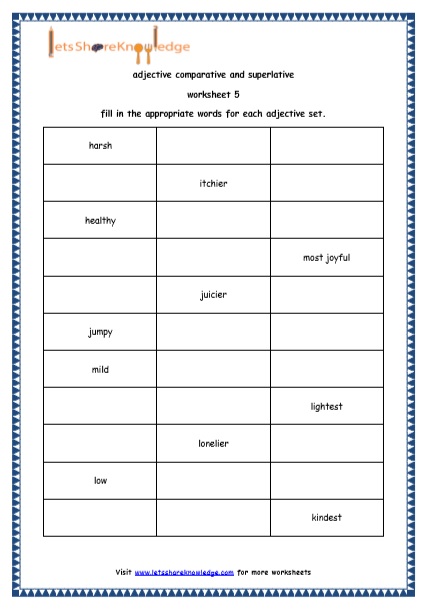
|
Worksheet 6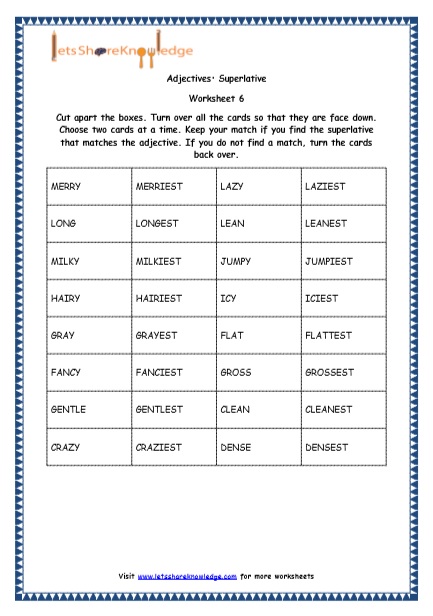
|
Worksheet 7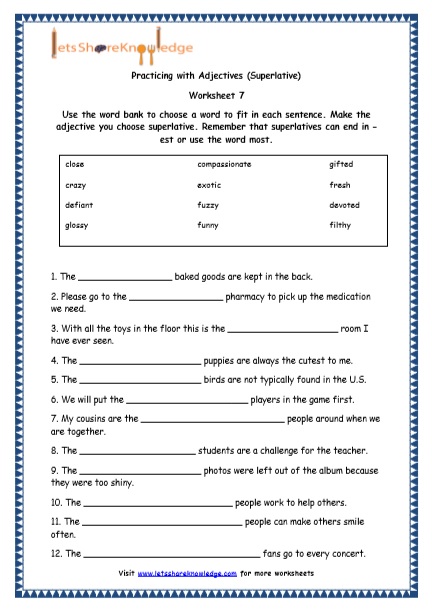
|
Worksheet 8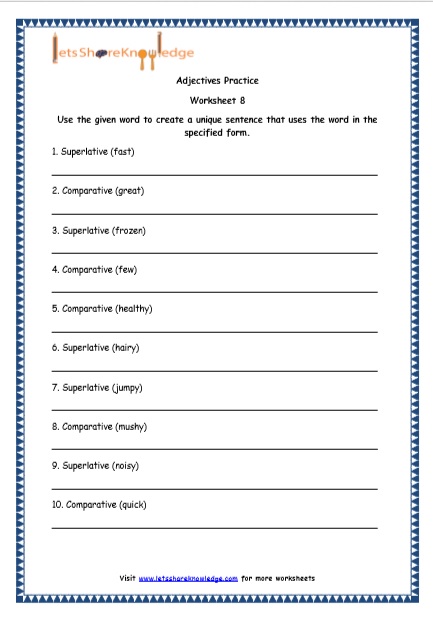
|
Worksheet 9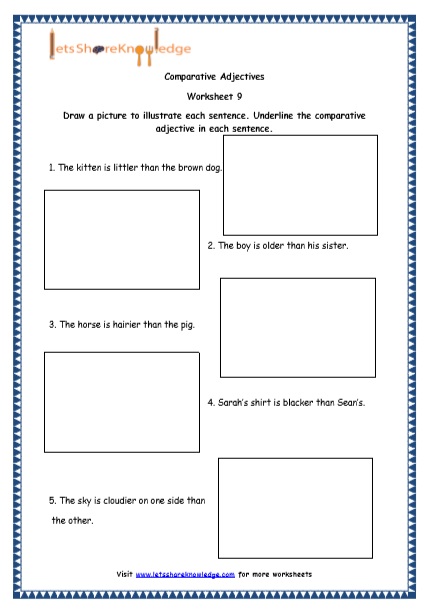
|
Worksheet 10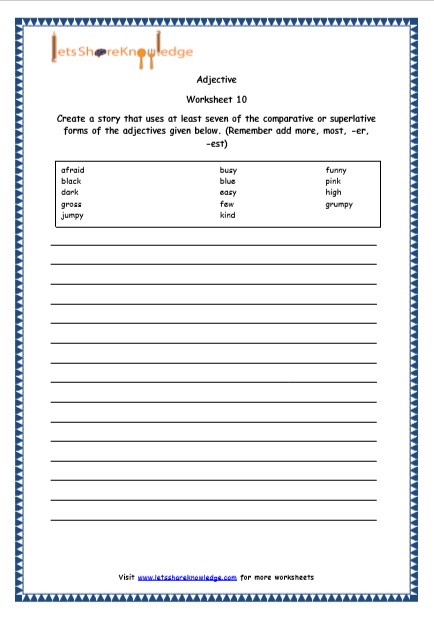
|
Click here for more Topics on Grade 4 English Worksheets!!
]]>These Grade 4 English resources and worksheets have answers also given in the downloadable links below.
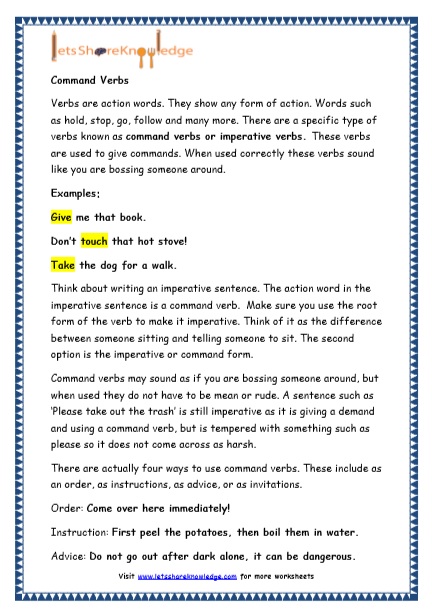
Command Verbs
Verbs are action words. They show any form of action. Words such as hold, stop, go, follow and many more. There are a specific type of verbs known as command verbs or imperative verbs. These verbs are used to give commands. When used correctly these verbs sound like you are bossing someone around.
Examples:
Give me that book.
Don’t touch that hot stove!
Take the dog for a walk.
Think about writing an imperative sentence. The action word in the imperative sentence is a command verb. Make sure you use the root form of the verb to make it imperative. Think of it as the difference between someone sitting and telling someone to sit. The second option is the imperative or command form.
Command verbs may sound as if you are bossing someone around, but when used they do not have to be mean or rude. A sentence such as ‘Please take out the trash’ is still imperative as it is giving a demand and using a command verb, but is tempered with something such as please so it does not come across as harsh.
There are actually four ways to use command verbs. These include as an order, as instructions, as advice, or as invitations.
Order: Come over here immediately!
Instruction: First peel the potatoes, then boil them in water.
Advice: Do not go out after dark alone, it can be dangerous.
Invitation: Sit down and try the cake, it is delicious.
Practice using and determining the appropriate command verb to use in the related worksheets.
Explanation
|
|
Worksheet 1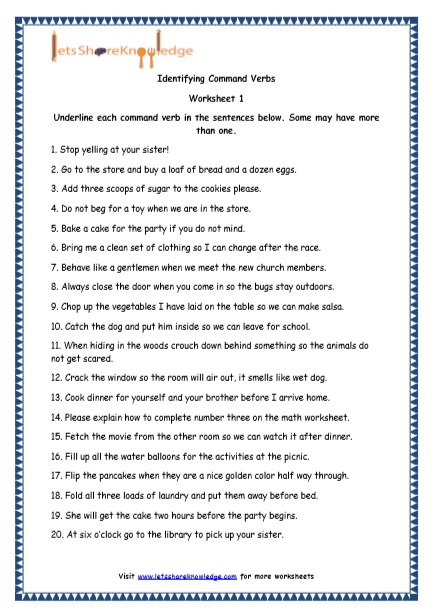
|
Worksheet 2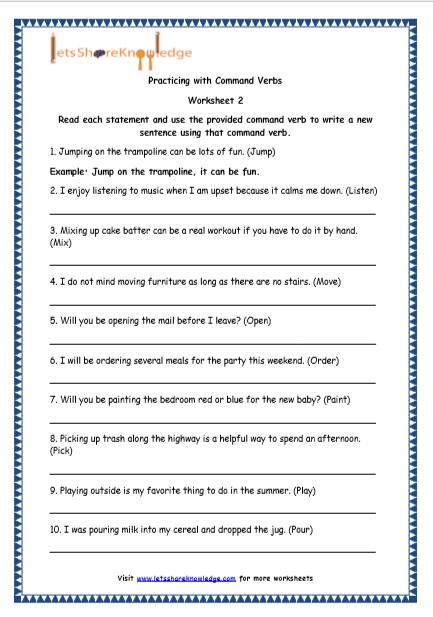
|
Worksheet 3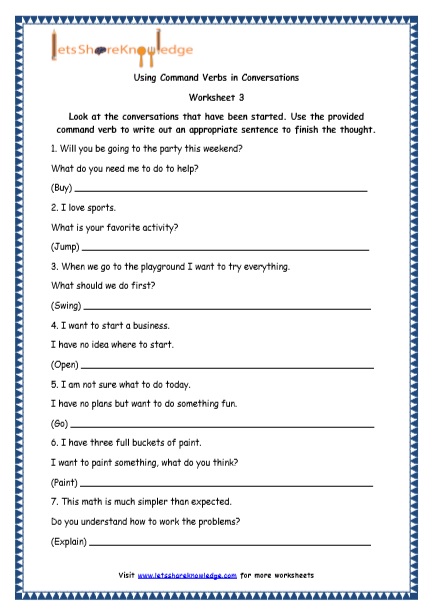
|
Worksheet 4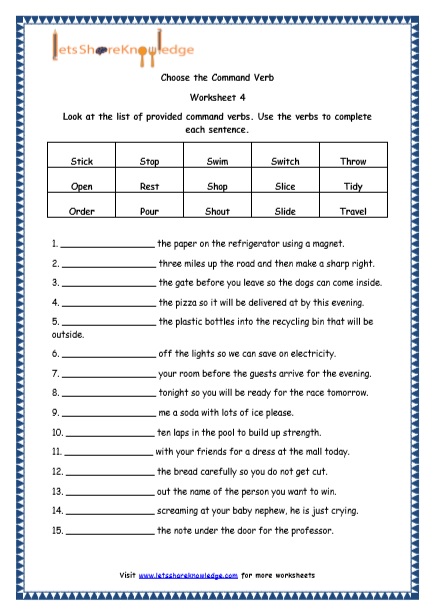
|
Worksheet 5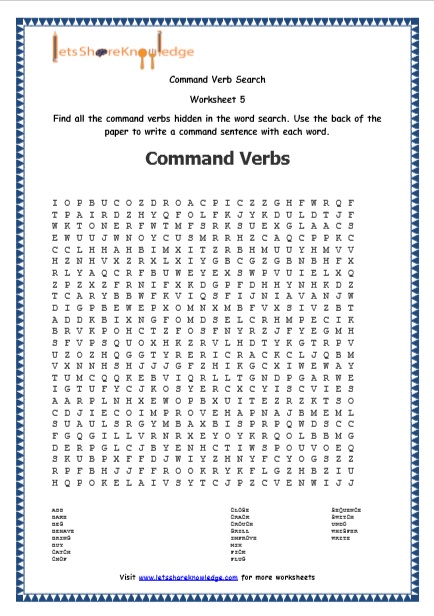
|
Worksheet 6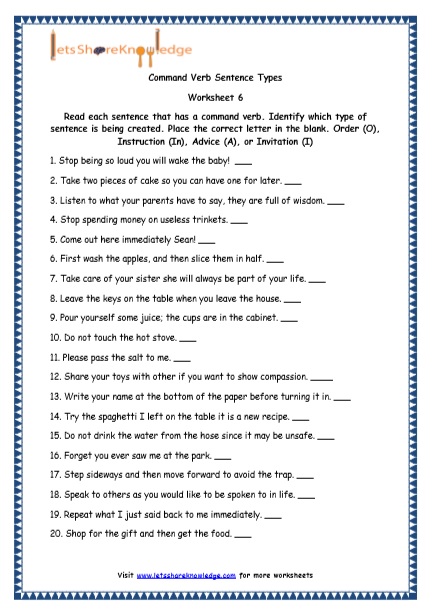
|
Worksheet 7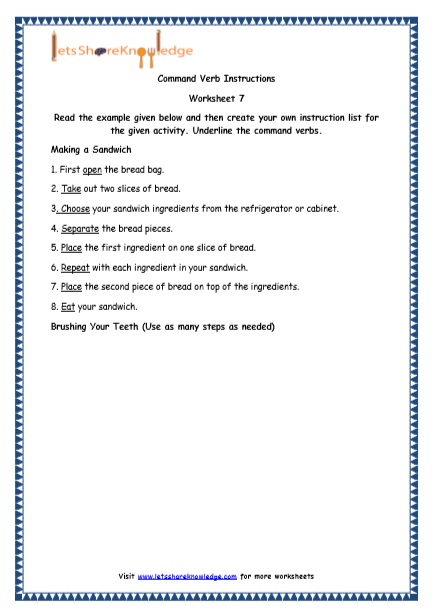
|
Worksheet 8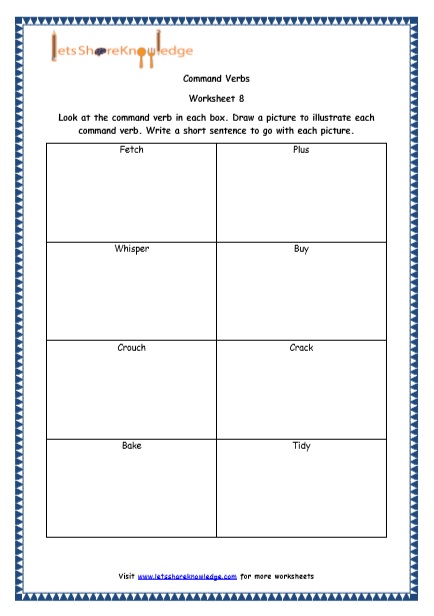
|
Worksheet 9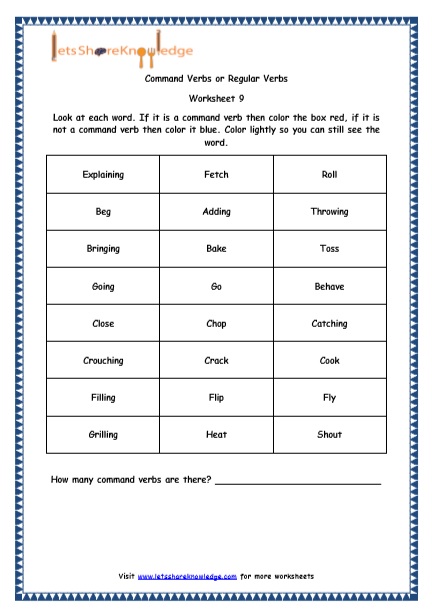
|
Worksheet 10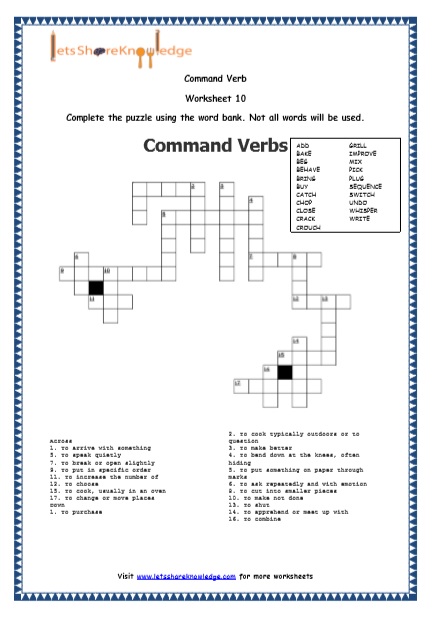
|
Click here for more Topics on Grade 4 English Worksheets!!
]]>These Grade 4 English resources and worksheets have answers also given in the downloadable links below.
Homonyms
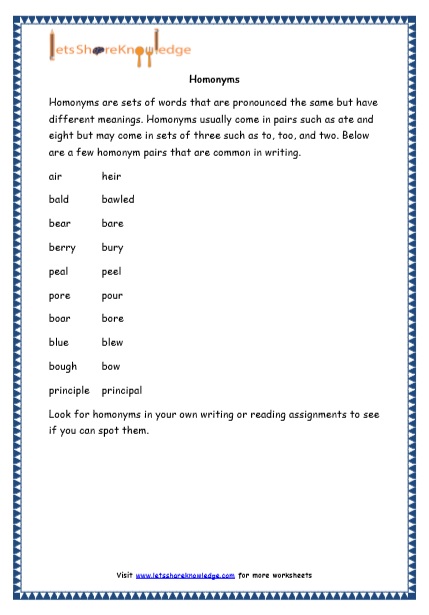
Homonyms are sets of words that are pronounced the same but have different meanings. Homonyms usually come in pairs such as ate and eight but may come in sets of three such as to, too, and two. Below are a few homonym pairs that are common in writing.
air heir
bald bawled
bear bare
berry bury
peal peel
pore pour
boar bore
blue blew
bough bow
principle principal
Look for homonyms in your own writing or reading assignments to see if you can spot them.
Explanation
|
|
Worksheet 1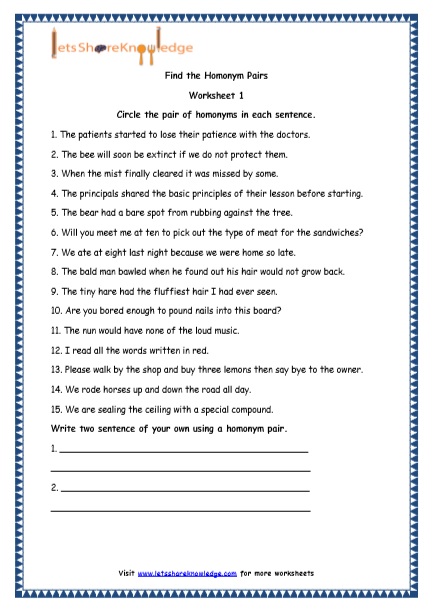
|
Worksheet 2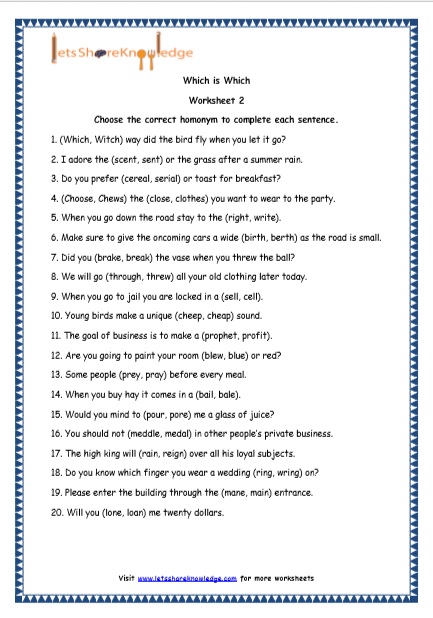
|
Worksheet 3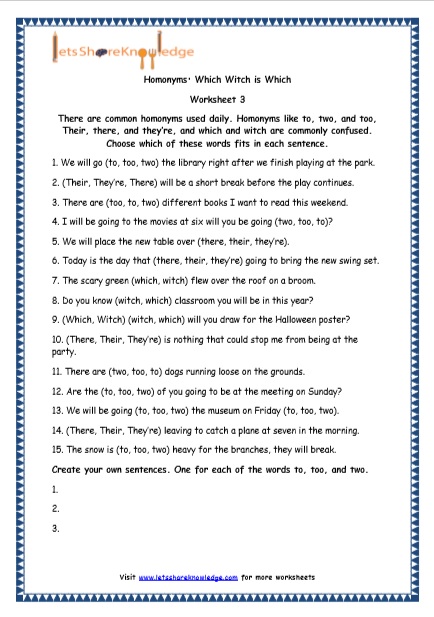
|
Worksheet 4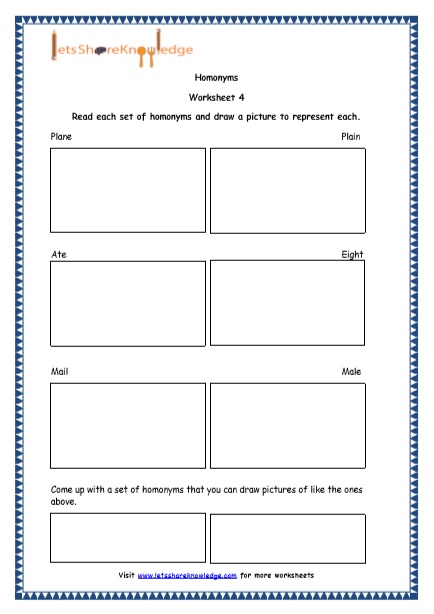
|
Worksheet 5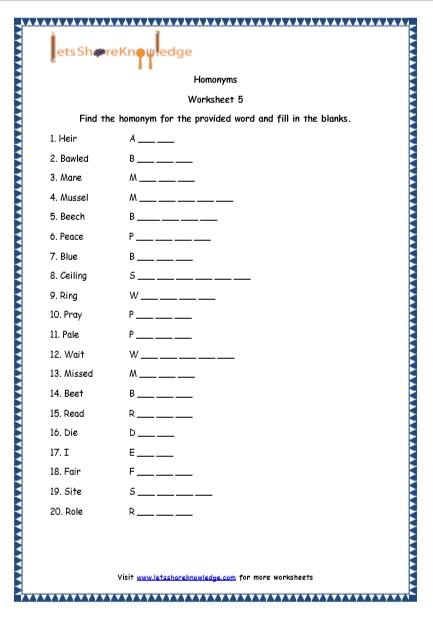
|
Worksheet 6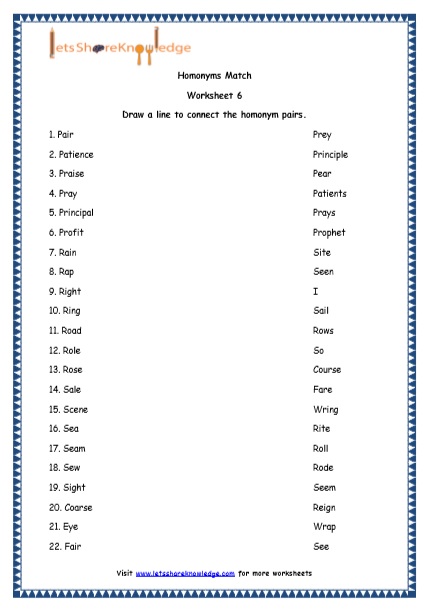
|
Worksheet 7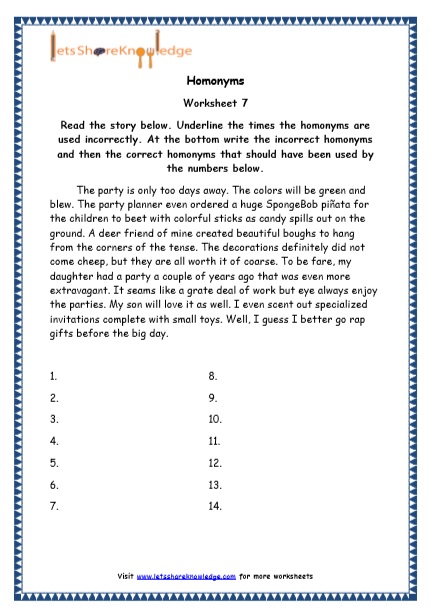
|
Worksheet 8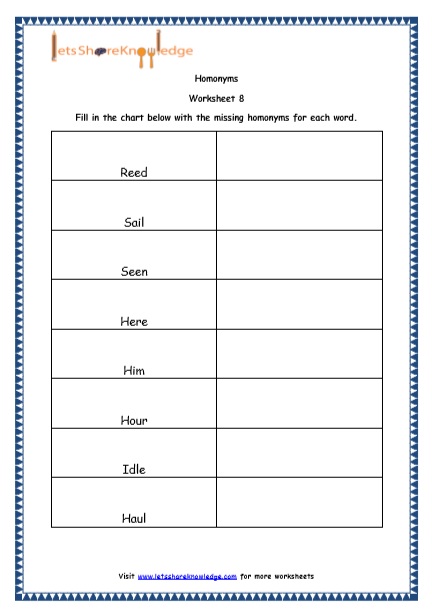
|
Worksheet 9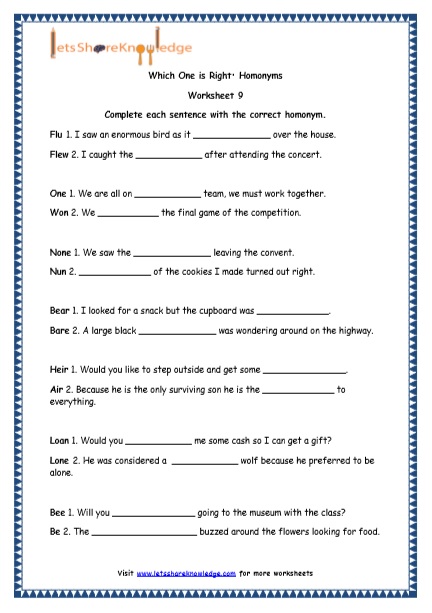
|
Worksheet 10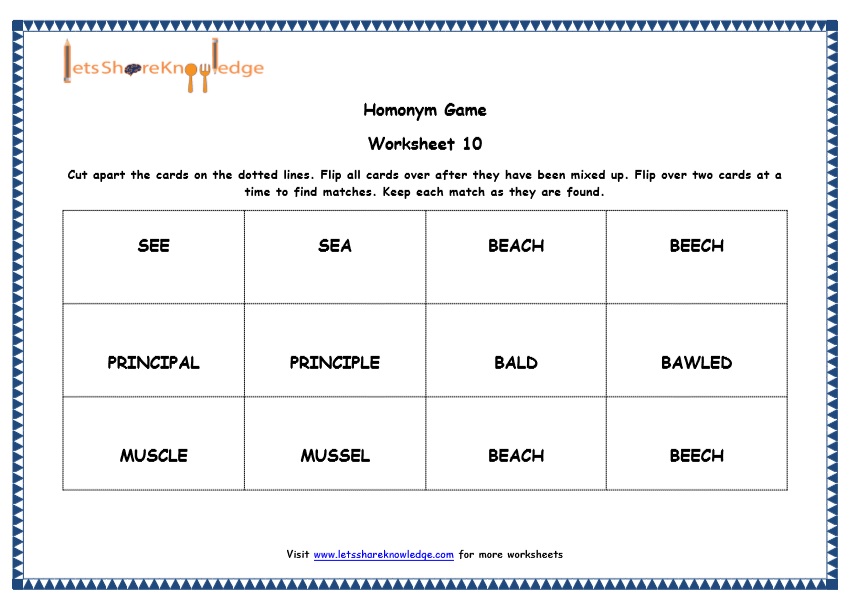
|
Click here for more Topics on Grade 4 English Worksheets!!
]]>These Grade 4 English resources and worksheets have answers also given in the downloadable links below.
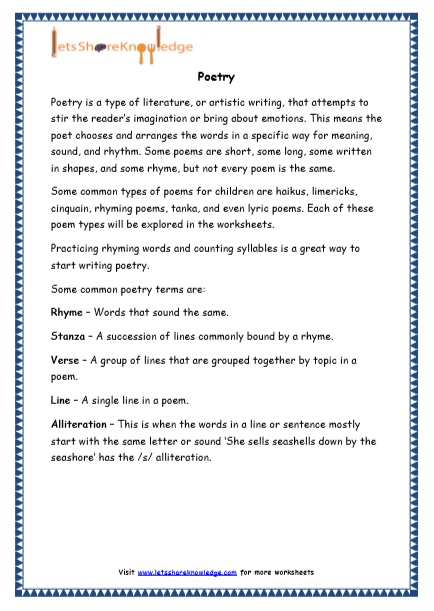
Poetry
Poetry is a type of literature, or artistic writing, that attempts to stir the reader’s imagination or bring about emotions. This means the poet chooses and arranges the words in a specific way for meaning, sound, and rhythm. Some poems are short, some long, some written in shapes, and some rhyme, but not every poem is the same.
Some common types of poems for children are haikus, limericks, cinquain, rhyming poems, tanka, and even lyric poems. Each of these poem types will be explored in the worksheets.
Practicing rhyming words and counting syllables is a great way to start writing poetry.
Some common poetry terms are:
Rhyme – Words that sound the same.
Stanza – A succession of lines commonly bound by a rhyme.
Verse – A group of lines that are grouped together by topic in a poem.
Line – A single line in a poem.
Alliteration – This is when the words in a line or sentence mostly start with the same letter or sound ‘She sells seashells down by the seashore’ has the /s/ alliteration.
Explanation
|
|
Worksheet 1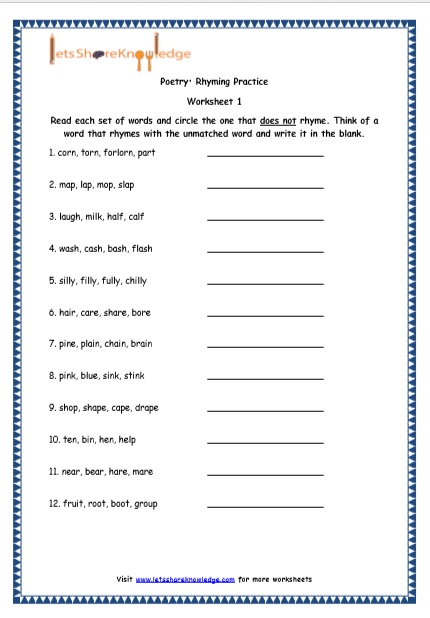
|
Worksheet 2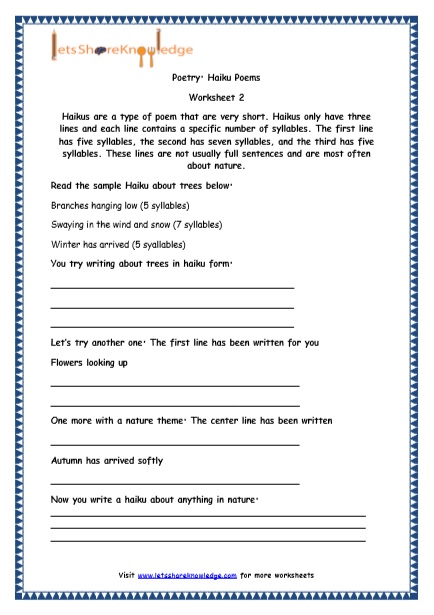
|
Worksheet 3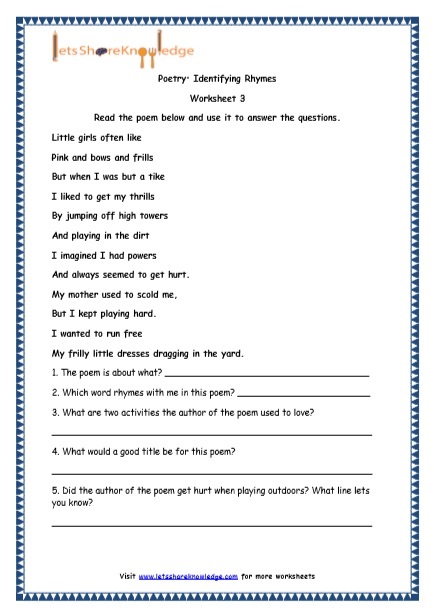
|
Worksheet 4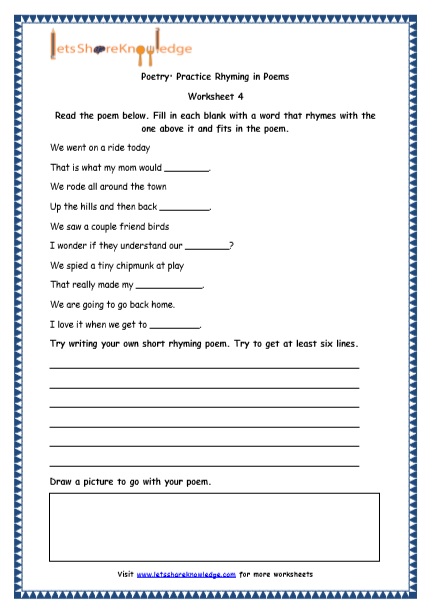
|
Worksheet 5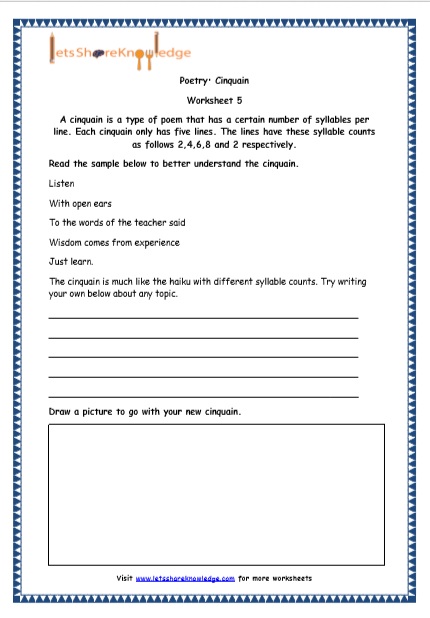
|
Worksheet 6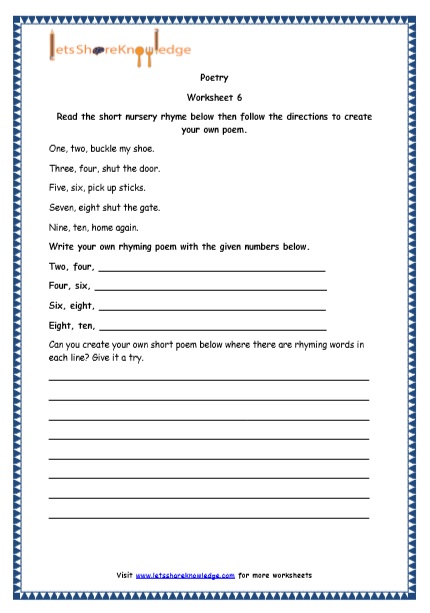
|
Worksheet 7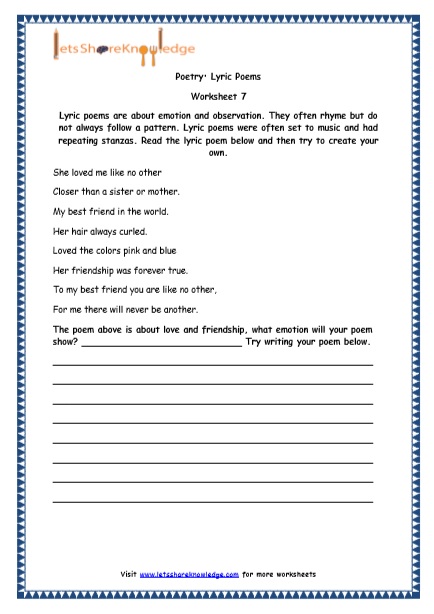
|
Worksheet 8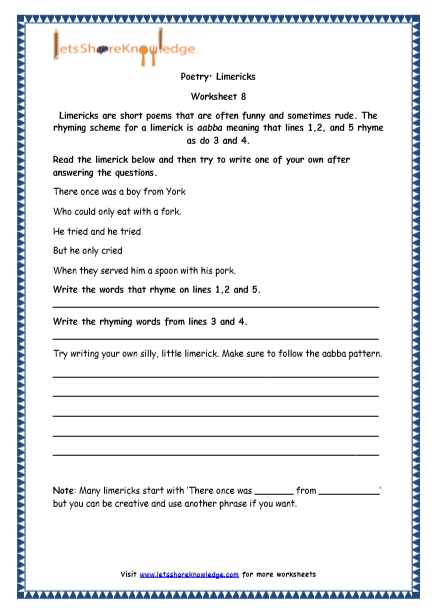
|
Worksheet 9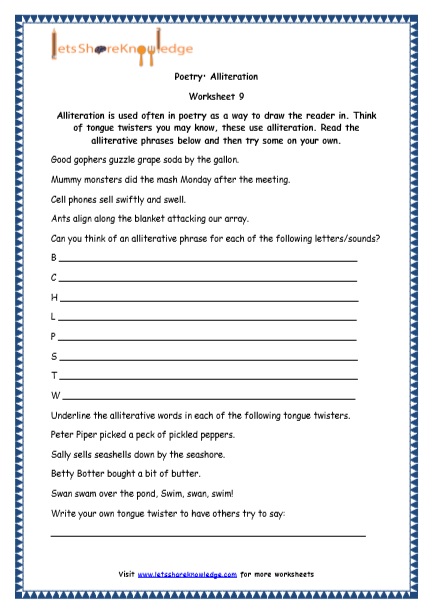
|
Worksheet 10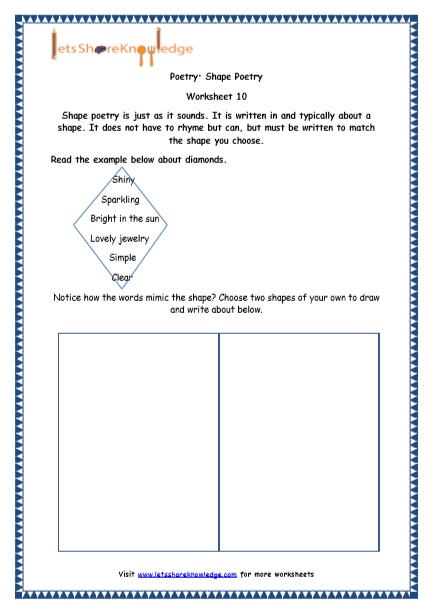
|
Click here for more Topics on Grade 4 English Worksheets!!
]]>These Grade 4 English resources and worksheets have answers also given in the downloadable links below.
Powerful verbs
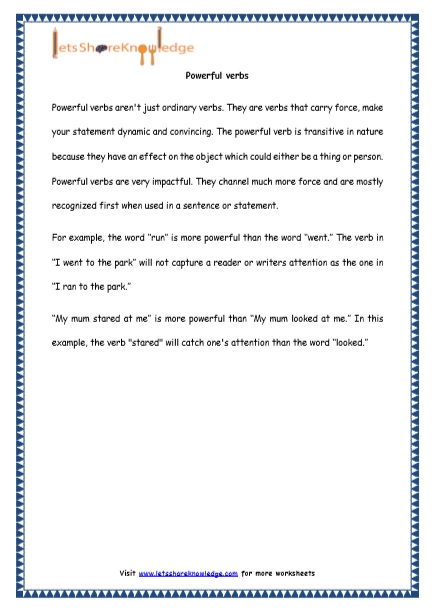
Powerful verbs aren’t just ordinary verbs. They are verbs that carry force, make your statement dynamic and convincing. The powerful verb is transitive in nature because they have an effect on the object which could either be a thing or person. Powerful verbs are very impactful. They channel much more force and are mostly recognized first when used in a sentence or statement.
For example, the word “run” is more powerful than the word “went.” The verb in “I went to the park” will not capture a reader or writers attention as the one in “I ran to the park.”
“My mum stared at me” is more powerful than “My mum looked at me.” In this example, the verb “stared” will catch one’s attention than the word “looked.”
Explanation
|
|
Worksheet 1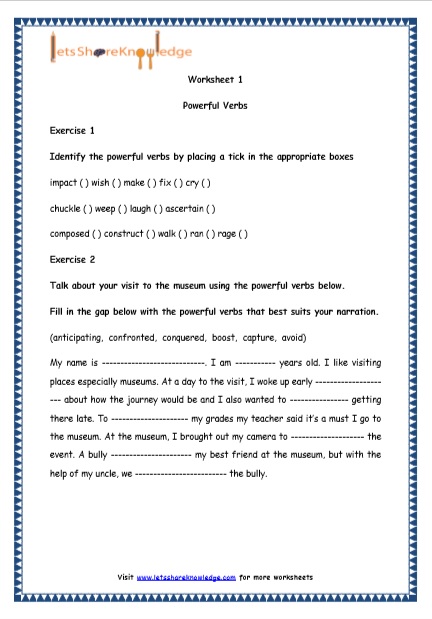
|
Worksheet 2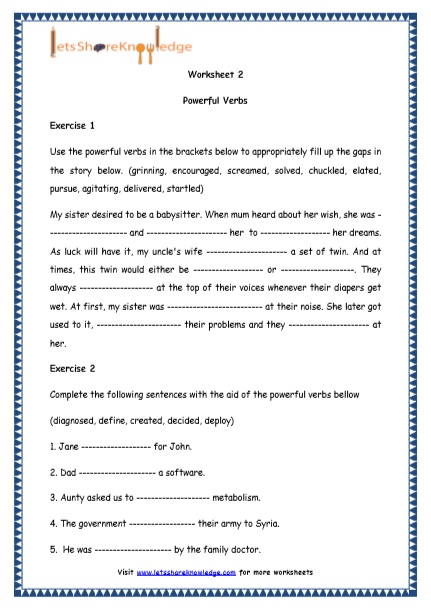
|
Worksheet 3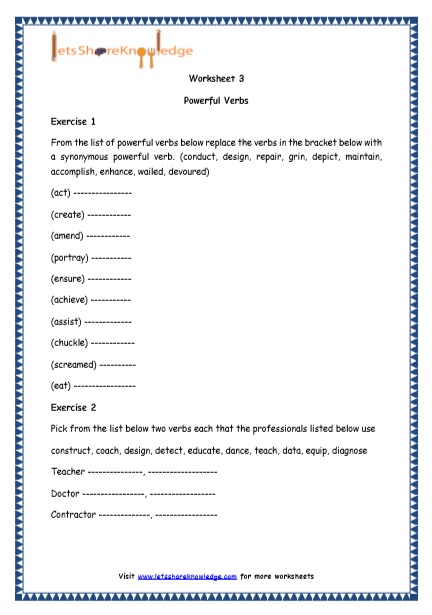
|
Worksheet 4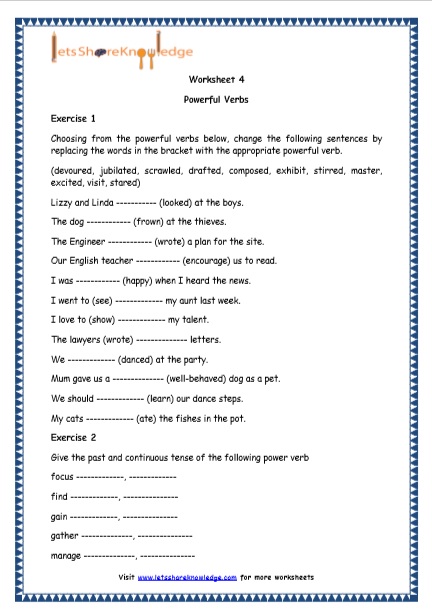
|
Worksheet 5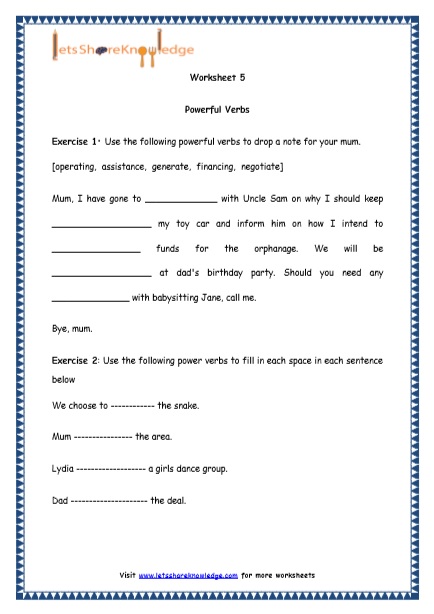
|
Worksheet 6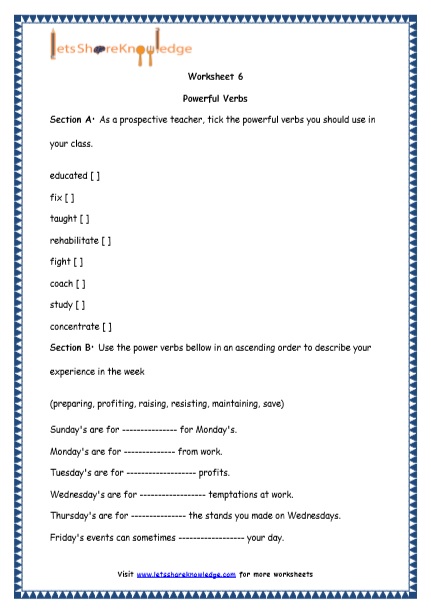
|
Worksheet 7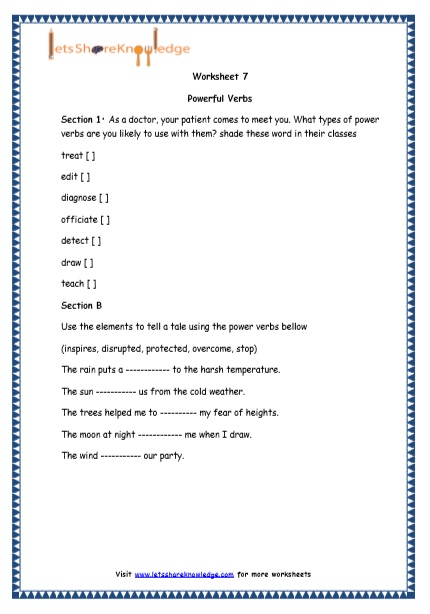
|
Worksheet 8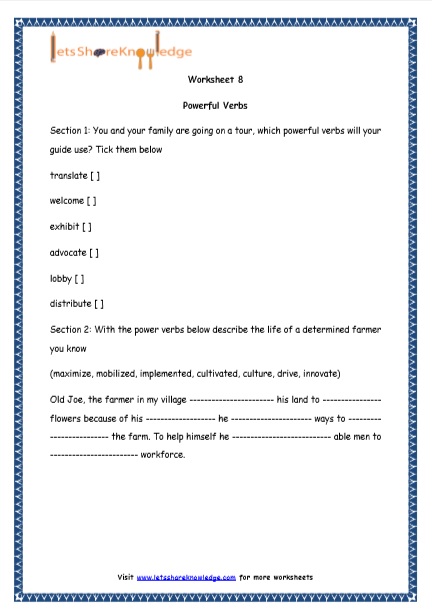
|
Worksheet 9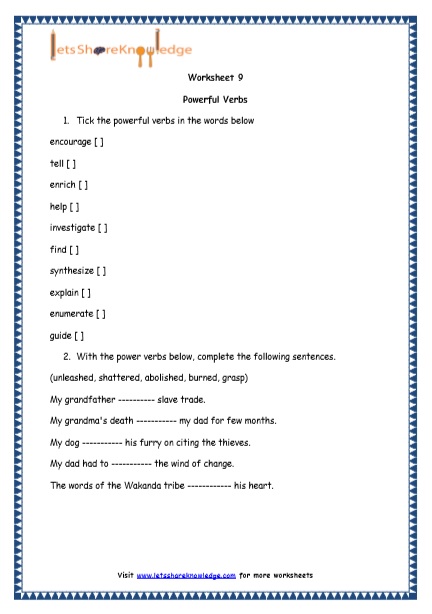
|
Worksheet 10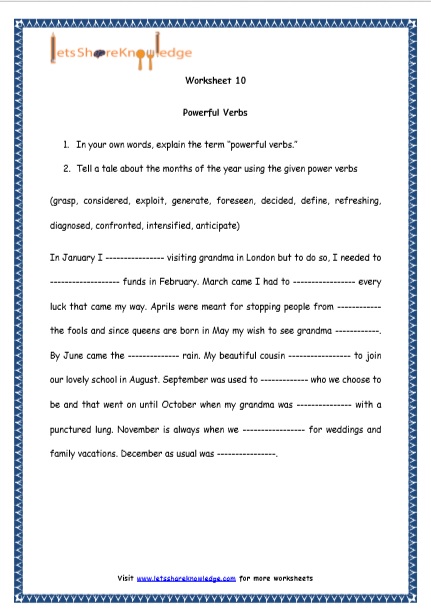
|
Click here for more Topics on Grade 4 English Worksheets!!
]]>